CameraQuest Home
Shopping Cart
Camera
Articles
I Buy / Wants Adapters
Join
RangeFinderForum.com
Voigtlander
Viewfinders &
Accessories
Cosina Voigtlander is quickly turning out new innovative, quality
accessories for not only their own cameras, but for rangefinders in general.
Compared to the stagnation in rangefinder design over the last 30 years, Cosina
Voigtlander's innovation
is breathtaking.
Voigtlander
15mm to 35mm Zoom Finder
Order Here
Type A Zoom Finder for full frame
rangefinders, 1.3x crop Leica M8/8.2 and 1.5x crop for Epson RD-1
Rangefinders and
APS-C cameras
with 1.5x crop factor
Type B Zoom
Finder for full frame rangefinders, 1.3x crop for
Leica M8/8.2 and 2x crop for Micro Four Thirds
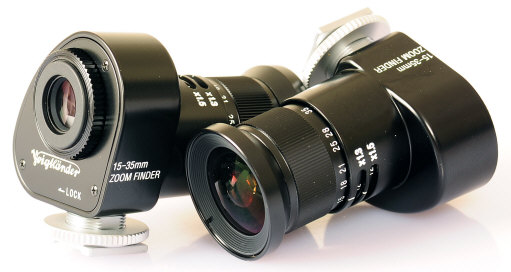
The Zoom
Finder's
eyepiece has built in diopter adjustment. The foot has a locking ring to lock
the finder in place upon your camera.
SIX for ONE! The
15-35 Zoom Finder has the same function as five separate finders: 15, 18, 21, 25, 28,
and 35.
Alas, these unique finders are discontinued.
Only a few remain. Get them while you still can!
"Stephen,
Just received my zoom Voigtlander finder.  WOW understated excellence.
This thing smokes the plastic 21mm Leica finder I own.  Makes that
expensive item look like a piece of junk.  Yikes, I had no idea it
could be that good.
The clarity of the image is excellent. Construction appears top notch.
Cheers

Tom Ridout"  www.industryous.com
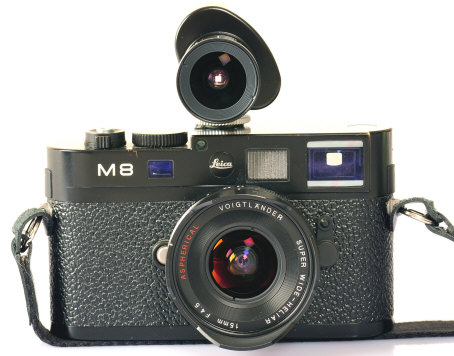
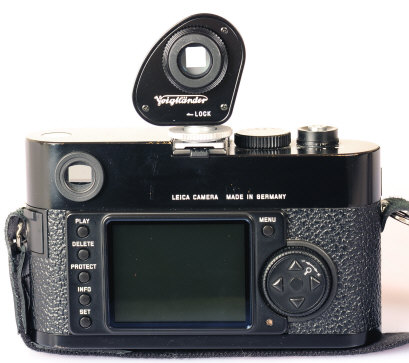
The ONLY
15 to 35mm Zoom Finder EVER made by any lens maker! The Voigtlander 15-35
Zoom Finder mounted on digital Leica M8.2 body with
Voigtlander 15/4.5 Super Wide lens.
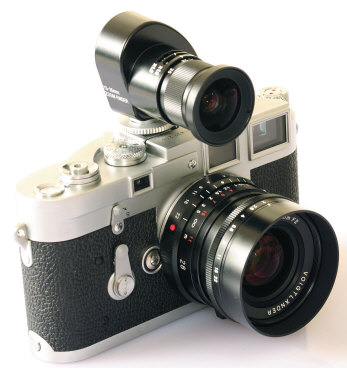
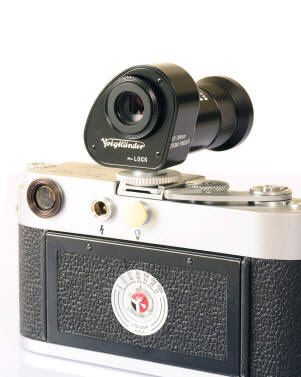
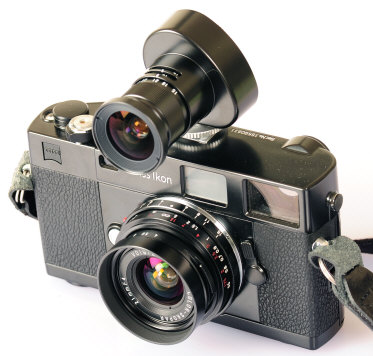
Zoom Finder mounted on Leica M3 and Zeiss
Ikon ZM
Hmm. How well will this Zoom finder work with the many many many fixed lens
point-n-shoots??
A finder for All Seasons, eh ALL Reasons, eh....ALL CAMERAS? Hot Damn!
Imagine: ONE viewfinder that can be used to
15mm to 35mm
wide angle lenses for 35mm rangefinder full frame cameras!
Thank You Mr. Kobayashi!
This is
about as UNIVERSAL as it gets in wide angle viewfinders! Covering
an ultra wide zoom range of 15 to 35mm, the amazing Voigtlander
15-35 Zoom Finder viewfinder can be used with virtually ALL
interchangeable 35mm full frame rangefinder cameras (digital or
film) by ALL manufacturers,
as well as the Leica M8, M8.2, Epson RD1 series, as well
as an amazing number of point and shoot cameras (film and digital).
WOW!
NEVER
before in the almost 100 year old history of 35mm rangefinder
cameras has a 15 to 35 viewfinder been produced by any camera
manufacturer, much less multi format for 3 different camera
families! Ladies and Gentlemen, WE HAVE A WINNER! The hottest thing
since sliced bread!
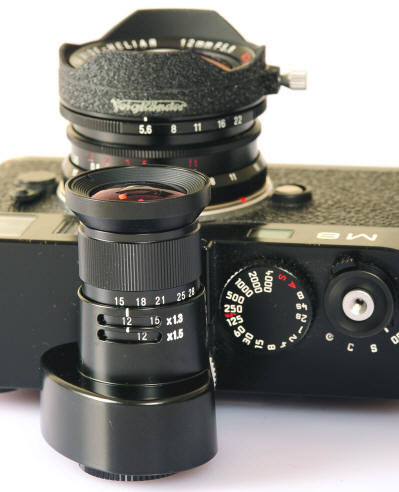
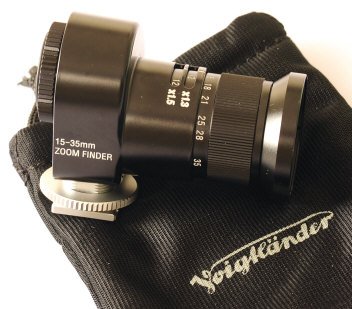
The Voigtlander
15-35 Zoom Finder is shown above mounted on digital Leica M8.2 body with
Voigtlander Ultra Wide 12/5.6 lens. Notice that due to the smaller than full
frame digital format, the Zoom Finder can be used with the 12mm lens on the M8.2
(1.3x scale) and Epson RD1 (1.5x scale). Simply turn the finder's barrel to
select the lens you are using. The Zoom Finder is delivered with its own
Voigtlander pouch, which of course can be used for other Voigtlander finders.
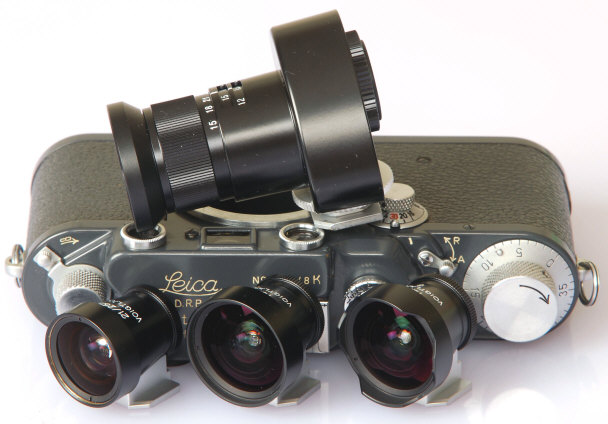
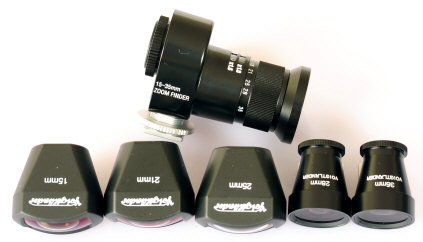
Voigtlander 15-35
Zoom Finder with the new metal Voigtlander 21/25, 15, and 12 Brightline
Viewfinders
DIFFERENT
CROP FACTORS
MEAN DIFFERENT LENS / VIEWFINDER COMBINATIONS!
For decades most
rangefinder viewfinders were only made for 35mm format. So you simply
used a viewfinder that matched up to your lens: a 35mm viewfinder with a
35mm lens. Recently smaller then
35mm full frame digital formats were invented: 1.3x for the Leica
M8/8.2, 1.5x for the Epson RD1, and 2x for Micro 4/3 cameras.
The lens focal length does
not change. But the Field of View or Crop Factor for that same lens
used on different formats does change.
A 28mm has the field of view of 28 x 1.3x
of a 36mm lens on a Leica M8/8.2, 28 x 1.5 = 42mm on a Epson RD1, and
28 x 2x = 56mm on a Micro 4/3 camera. So that same 28mm lens will need
a 35mm viewfinder on the Leica M8/8.2, a 40mm viewfinder on the Epson
RD1, and a 50mm viewfinder (the closest standard VF made to 56mm) for a
Micro 4/3 camera. Confusing? Perhaps, but keep at it and it will make
sense.
Type A Zoom Finder covers 15-35 lenses
35mm full frame
format rangefinders, film or digital, the Leica M10 series, M240 series, M9
series, all the M film cameras
plus
Leica M8 / M8.2 1.3x
format for 12mm to 25mm lenses
(marked values)
plus
Epson RD1
1.5x format 12mm to 21mm lenses
(marked values)
Sony NEX
cameras and Ricoh GXR M are also covered, as they have the same 1.5x
crop factor as the RD-1!
Type A Zoom Finder covers 15-35 lenses
35mm full frame
format rangefinders, film or digital, the Leica M10 series, M240 series, M9
series, all the M film cameras
plus
Leica M8 /M8.2 1.3x
format for 12mm to 25mm lenses
(marked values)
plus
Micro 4/3 cameras
2x format for 7.5mm to 17.5mm
lenses (marked
values)
Voigtlander 15mm
to 35mm Zoom Finder Specs
-
Click stops at 15mm, 18mm,
21mm, 25mm, 28mm, 35mm full frame lens sizes
-
Adjustable between click sizes, for
example between 16mm and 18mm
-
8 elements in 7 groups, 3 prisms
-
Eyepiece Diopter continuously
adjustable from +1.3 to -2.8
-
Parallax lines at top of image show cut
off at 1 meter - full image for infinity viewing
-
Eye Relief: 15mm from eyepiece
-
Image magnification -- zooming .22x to
.47x life size
-
Size: 42.5x49.5x65.4mm
-
Weight 98 grains
-
Small carrying pouch included with
viewfinder
-
Roughly half the size of the Leica
16-28 Universal Wide Angle Finder
-
Turn locking ring to lock viewfinder
into camera's accessory shoe
-
Image ratio Horizontal to Vertical 3:2
-
How to tell difference between Type A &
B? Type A has 1.5x setting, Type B has 2x setting
-
RANGEFINDER
NEWBIES: Focus the lens using the camera's rangefinder, then
switch your eye to the viewfinder to compose your shot. Its reason
for being is to provide a viewfinder for wide angles -- wider than
what your camera's own built in viewfinder provides. Of course the
widest built in viewfinder coverage varies from camera to camera
model.
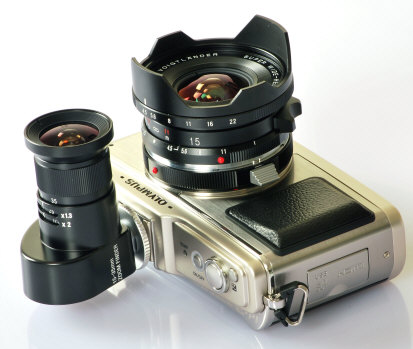
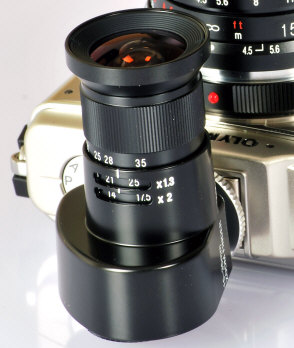
Type B
Zoom Finder adjusted for the Voigtlander 15mm lens mounted on the Olympus EP1
Tom Abrahamson's
Take on the Voigtlander 15-35 Zoom Finder
I am just back from Japan and I had a chance to play with the
15-35 finder. As with all CV finders, it is incredible bright -
virtually no light loss looking through it! It is a zoom finder
so you don't have the "surround" of a frame line finder. It
zooms in to the focal length and shows the image against a black
background instead.
It has three different scales on it. The primary one, a chrome
ring" shows the focal length for 24x36mm, the second scale (cut
out and white numbers against a black back ground) shows a 1,3
size (M8) and the third scale shows the 1.5 magnification of a
RD -1. Sound cluttered but actually worked nicely.
Some distortion at extreme wide setting (15/18 mm) but not worse
than on a dedicated finder. The foot has a screw down lock on it
so that it is held down securely. Not small, but better than the
Leica AM/FM radio looking thing. Oh, almost forgot - it has a
built in diopter adjustment on the eyepiece too!
Before you all ask - No, I don't know the price - but even so I
want one! It would make my Bessa T's very useful too.
I also had the opportunity to use the coupled 15f4.5 Heliar.
Very nice package - M-mount and high build quality. Feels rock
solid and a 52mm filter size justifies a miss-spent youth with
Nikon F's and the lenses for that. I have a lot of those 52mm
filters to put to use once the M-mount 15f4.5 makes its way to
me.
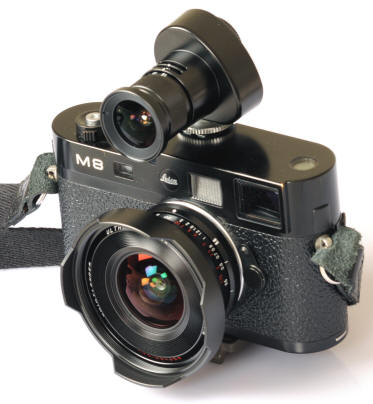
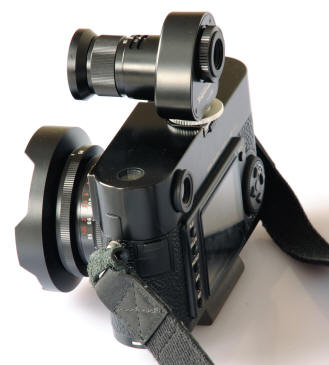
The smaller format Leica M8/8.2 as well as the Epson RD1
can use the Voigtlander 15-35 Zoom Finder with 12mm or 15mm lenses!
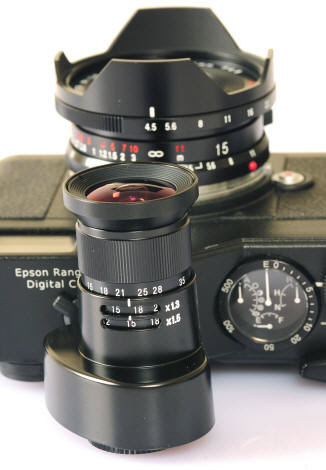
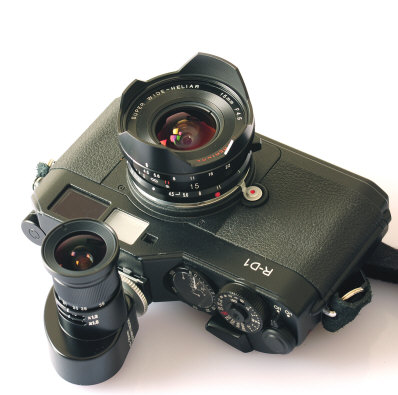
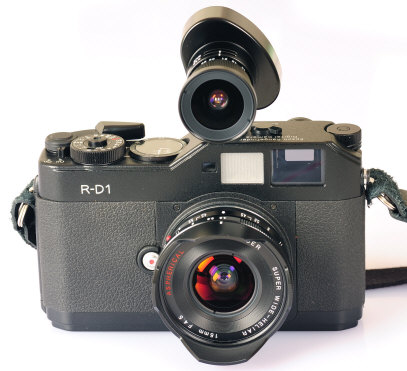
Epson RD1 digital M mount rangefinder with
Voigtlander 15-35 Zoom Finder and Voigtlander 15/4.5 M mount super wide
angle lens. Notice the finder is set at 15 in the 1.5x scale -- the
format size for the RD1
10, 12, 15, 21, 25, 28, 35,
40, 50, 75, 90 Viewfinders
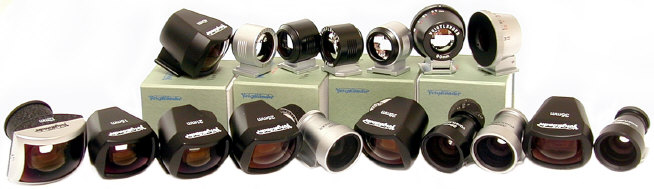
Left to Right: Top Row 40, 50 Silver, 50 Black,
75 Black, 75 Silver, 90 Black, 90 Silver -- Bottom Row 12, 15, 21, 25, 28 Metal
Chrome, 28 Plastic, 28 Metal Black, 35 Metal Chrome, 35 Plastic, 35 Metal Black.
Which newly introduced viewfinders are missing from this pic?
Generally all Voigtlander finders offer
bright clear views at a fraction of the price of Leica M accessory finders.
I
am not alone in believing that for all practical purposes, the Voigtlander
finders are just as good as their more expensive Leica M counterparts, and
they are sometimes better. Six Version I finders use the same outer plastic
housing: 15, 21, 25, 28, 35, 40. Likewise the 28 and 35 metal brightline
finders also share the same outer housing, while the 50 and 75 brightlines
also share an outer housing. The 50, 75, and 90 are all have 1x
magnification, or life size finders. The 28, 35, 50, 75, and 90
finders are of a retro style with beautiful fit and finish. They are a
perfect match to many classic rangefinders.
New Brightline
Voigtlander 10mm Viewfinder
Order Here
- the 1st and only 10mm rangefinder viewfinder
pics soon
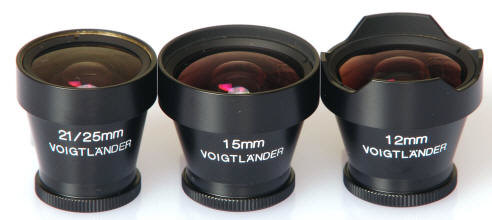
2010 Update: New improved Metal Version II 12mm, 15mm and 21/25mm viewfinders were introduced.
New Brightline
Voigtlander 12mm Viewfinder II
Order Here
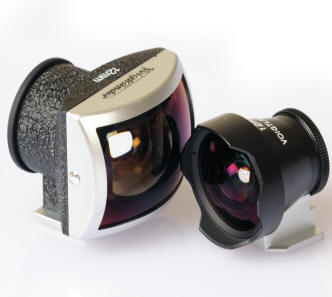
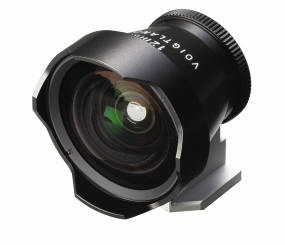
The new smaller version II 12mm
viewfinder was introduced in 2010 with the new M mount 12/5.6 lens.
Version II is more expensive than its predecessor, but now
provides not only a brightline, but also an improved brighter image with
less distortion! It uses the same basic viewfinder housing as the
new metal 15 viewfinder.
12 VF II Tech Specs: 5
elements in 5 groups, .28 magnification, -.32 diopter, weight 55 grams,
brightline shows 92% of on film image at 3 meters.
Voigtlander
12mm
Viewfinder I Discontinued / Sold Out
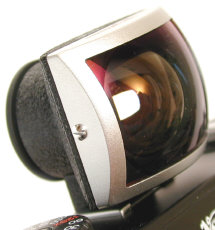
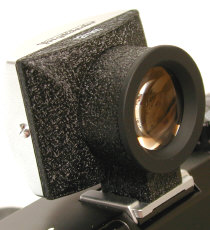
The Voigtlander 12mm
Viewfinder I is all metal
with a black crinkle finish with a bright sharp image but no brightline frameline.
It contains aspherical elements and is difficult to manufacture. This
version 12 viewfinder is included with the Leica screw mount 12/5.6 lens. Some people have had their heavy 12mm finder fall off the
camera, killing itself on concrete or rocks. So be careful with it.
Like most wide angle finders, it has no manual parallax compensation.
12 VF I Tech Specs: 4
elements in 4 groups, .36 magnification, -1 diopter, weight 68 grams.
New Brightline
Voigtlander 15mm Viewfinder II
Order Here
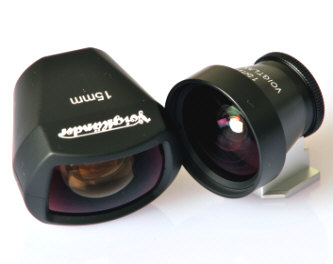
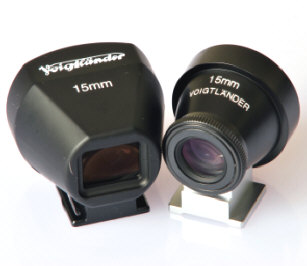
Side by Side: The Version I and Version II Voigtlander
15mm Viewfinders
The new smaller version II 15mm
viewfinder was introduced in 2010 with the new M mount 15/4.5 lens.
Version II is more expensive than its predecessor, but now provides not
only a brightline, but also an improved brighter image with less
distortion! It uses the same basic viewfinder housing as the new
metal 12 viewfinder. Note Version II has a
metal foot, while Version I uses a plastic foot.
Voigtlander 15mm Viewfinder
I
Order Here
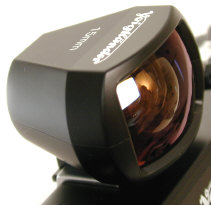
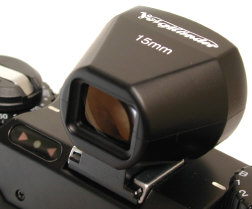
The 15 finder has a clear,
wide, bright views, but no brightline. The 15 and 25 finders are the same
size, but clearly labeled, available in black only.
It has glass optics and a hard to scuff outer plastic casing.
Like most super wide angle
finders, it has no manual parallax compensation.
15 VF
Tech Specs: 93% of view at 3 meters, no brightline, 4 elements in 4 groups, .38
magnification, -1 Diopter, weight 33 grams.
Voigtlander 18mm Viewfinder
Discontinued / Sold Out
Voigtlander did not officially make a 18mm Viewfinder
BUT the Brightline 12mm RD1 Viewfinder =
18mm on Full Frame!
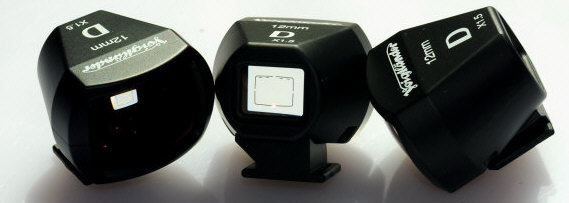
This viewfinder is discontinued and sold out at the factory, only a few
remain at CameraQuest
Voigtlander 21mm Brightline Viewfinder
I Discontinued / Sold Out
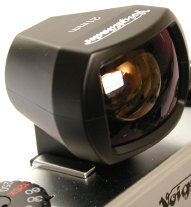
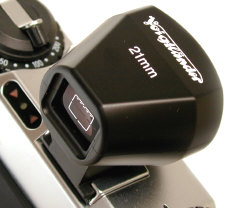
The 21 brightline finder was introduced in
May 2001 with the 21/4. It has glass optics and a
hard to scuff outer plastic casing. The
Voigtlander 21 finder is especially interesting as an inexpensive alternative
to the expensive Leica 21 brightline, Contax 21 finder, or Nikon 21 finders. Many shooters find they prefer the Voigtlander 21 finder to
the Leica. Like most wide angle finders, it has no
manual parallax compensation -- but it does have parallax compensation marks
in the finder. The lower dotted brightlines
indicate the approximate view at about 3 feet. The upper solid brightlines
indicate the approximate view at infinity. 21 VF Tech Specs: .42 magnification, 5 elements
in 4 groups, -1 Diopter, weight 31 grams. April 2010: the 21 viewfinder
was discontinued and replaced by TWO different 21/25 combination
viewfinders - one metal bodied and one plastic bodied. The 21mm
Version I viewfinder is still available while supplies last.
Voigtlander
25 Brightline Viewfinder I Discontinued / Sold Out
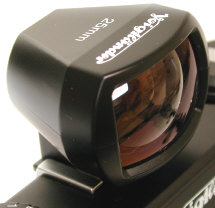
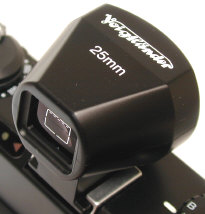
The original 25 Voigtlander finder introduced in
January 1999 did not have brightlines. In January 2001 a new 25 brightline
finder was introduced with the SC 25 lens for Nikon and Contax rangefinders.
Over the next few months the new brightline began shipping with the 25
Leica screw mount lens. If your 25 Voigtlander finder has no
brightlines, it is the older version. Both
versions use glass optics and a hard to scuff outer plastic casing. Like most wide angle finders, it has no
manual parallax compensation -- but it does have parallax compensation marks
in the finder. The lower dotted brightlines
indicate the approximate view at about 3 feet. The upper solid brightlines
indicate the approximate view at infinity. 25 VF
Tech Specs:
92% of view at 3 meters, no brightline, 4 elements in 4 groups, .49 magnification, -1
Diopter, weight 30 grams. April 2010: the 21
viewfinder was discontinued and replaced by TWO different 21/25 combination
viewfinders - one metal bodied and one plastic bodied.
NEW Metal Voigtlander 21/25mm Combination Brightline Viewfinder
Order Here
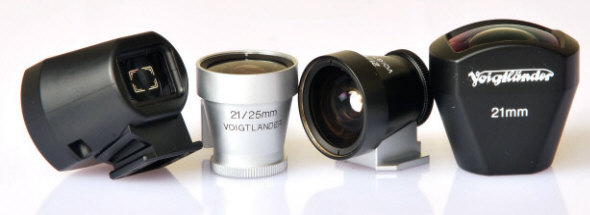
April 2010: Voigtlander replaced
the 21 and 25 brightline finders with a new metal COMBINATION 21/25 Brightline Viewfinder.
The metal
21/25 version offers a slightly brighter image with less distortion.
Note Metal 21/25 has a
metal foot, while plastic bodied 21/25 uses a plastic foot. Left
to right above: the plastic bodied Voigtlander viewfinder,
chrome and black versions of the metal 21/25 Voigtlander viewfinder, and
the Voigtlander 21mm Version 1 viewfinder for size comparison.
The
older 21 and 25 Version I viewfinders are discontinued but still available while
supplies last.
Voigtlander
28mm Brightline Viewfinder
I Discontinued / Sold Out
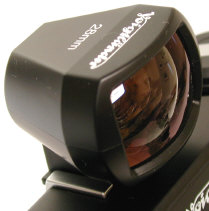
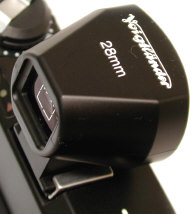
The 28 plastic brightline finder
has glass optics and a hard to scuff outer plastic casing. Parallax
correction marks are in the finder. Image is bright and clear. For
all practical purposes the image is the same as the chrome Leitz brightline.
The much lower cost of the Voigtlander finder makes it a best buy.
Like most wide angle finders, it has no
manual parallax compensation -- but it does have parallax compensation marks
in the finder. The lower dotted brightlines
indicate the approximate view at about 3 feet. The upper solid brightlines
indicate the approximate view at infinity. 28
Plastic VF Tech Specs: 5 elements in 4 groups, .5 magnification, -1
Diopter, weight 28 grams. Version I was replaced by the improved metal
bodies Version II 28mm brightline finder.
Voigtlander
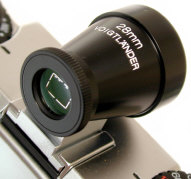
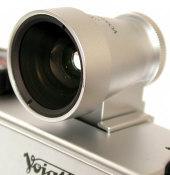
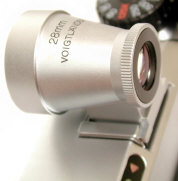
28mm Metal Brightline Viewfinder -- Superb 28mm VF
Order Here
Discontinued
The Voigt 28 Viewfinder is proving very popular on the Ricoh GR and Sigma DP1
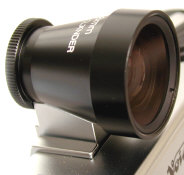
January 2003 saw the
introduction of a new all metal 28 brightline High Point brightline finder.
It is a great 28 brightline viewfinder, bettered
only by the much more expensive Zeiss Ikon 25/28 finder. .
With its High Point design, all the corners are easily seen by a person
wearing glasses. The
fit and finish of the metal finder is quite high. Like most wide angle finders, it has no
manual parallax compensation -- but it does have parallax compensation marks
in the finder. The lower dotted brightlines
indicate the approximate view at about 3 feet. The upper solid brightlines
indicate the approximate view at infinity. I
expect the metal 28 brightline finder to become quite popular. Not
only is it a great 28 finder, it also looks right at home
on classic cameras such as the screw mount Leicas, screw mount Leica copies,
Leica M3, classic Contax, and Nikon S2. 28
Metal VF Tech Specs: 3 elements in 3 groups, .43 magnification, -1
Diopter, weight 51 grams.
Voigtlander
28 / 35mm Brightline Mini-Viewfinder -
when available
Order Here
The Voigt
28/35 Viewfinder is proving very popular on the Ricoh GR and Sigma DP1,
Ricoh and Epson RD1
MINI-FINDERS
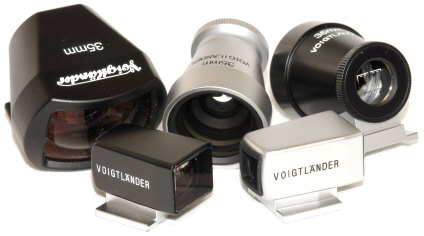
Black
and chrome Mini-Finders along side the current metal black and chrome
35mm viewfinders
and the
discontinued plastic 35mm viewfinder
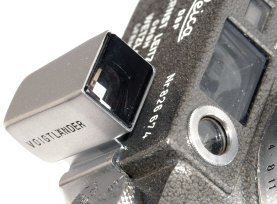
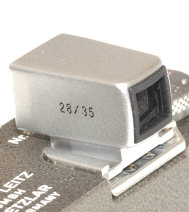
Introduced at PMA in Las Vegas
February 2004, the 28/35 Brightline Mini-Finder
weighs in at an amazing 19grams. It has .5 Magnification, a minus .5 Diopter adjustment,
and 5 elements in 5 groups. Both the 28
and 35 brightlines are visible at all times. Chrome and black versions
are available. Mini-Finders are shown here besides the larger
Voigtlander 35 metal finders, and the plastic 35 finder. While the
larger metal 28 or 35 finders are quite simply the best 28 and 35 brightlines
ever made, the combination 28/35 Mini-Finder is still compares well to them.
Parallax at 3 feet / 1 meter is indicated by a line at the top right of the
brightlines.
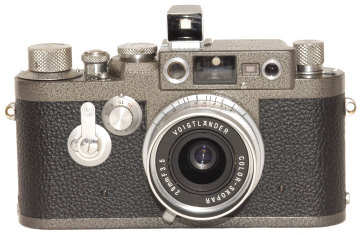
The 28/35 Mini-Finder is a particularly good compact finder
choice for Leica screw mount bodies, the
Leica M3, and Voigtlander R3A / R3M (which have no 28 or 35 framelines).
The 28/35 Minifinder is shown here mounted on my Shintaro painted hammertone
Leica IIIg.
Voigtlander
35mm Brightline Viewfinder I - Discontinued / Sold Out
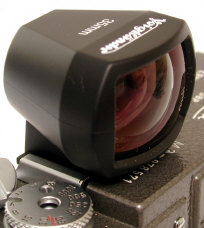
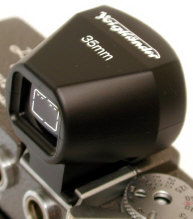
The 35 plastic brightline
finder has glass optics and a hard to scuff outer plastic casing.
Parallax correction marks are in the finder. Image is bright and clear.
For all practical purposes the image is the same as the chrome Leitz
brightline. The much lower cost of the Voigtlander finder makes it a
best buy. Like most wide angle finders, it has no
manual parallax compensation -- but it does have parallax compensation marks
in the finder. The lower dotted brightlines
indicate the approximate view at about 3 feet. The upper solid
brightlines
indicate the approximate view at infinity. 35
Plastic VF Tech Specs: 4 elements in 4 groups, .68 magnification, -1
Diopter, weight 24 grams.
Voigtlander
35mm Metal Brightline Viewfinder --
Superb 35mm VF
Order Here
Discontinued
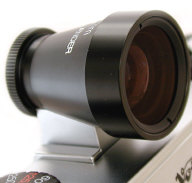
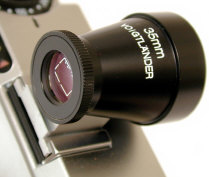
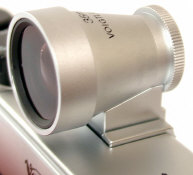
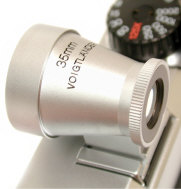
March 2003 saw the
introduction of a new all
metal 35mm brightline finder with the 35/1.2. It became available June
2003. In my opinion it is the best 35mm
brightline finder I have ever seen.
With its High Point design, all the corners are easily seen by a person
wearing glasses. The
fit and finish of the metal finder is quite high. Like most wide angle finders, it has no
manual parallax compensation -- but it does have parallax compensation marks
in the finder. The lower dotted brightlines
indicate the approximate view at about 3 feet. The upper solid
brightlines
indicate the approximate view at infinity.
I expect the metal 35 brightline finder to become quite
popular. Not only is it the best 35 brightline in my opinion, it
also looks right at home on classic cameras such as the screw mount Leicas,
screw mount Leica copies, Leica M3, classic Contax, and Nikon S2. This
35mm finder has proven VERY popular with Leica X1 owners.
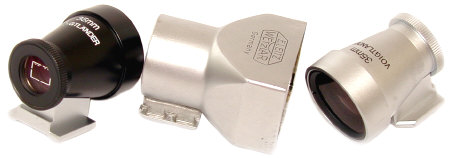
In the center is the classic chrome Leitz 35
brightline, compared to the smaller Voigtlander metal 35 brightline.
Voigtlander 40mm
Brightline Viewfinder -- Discontinued / Sold Out
replaced
by improved metal 40mm Brightline Viewfinder
Sigma DP2 - also great with the
Voigtlander 40mm Viewfinder! More eye relief than the Sigma finder!
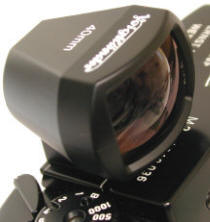
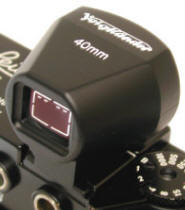
March 2002 saw
the introduction of a new 40mm brightline finder. It has glass
optics and a hard to scuff outer plastic casing.
The
same finder was with Rollei label was also sold as an accessory for the Cosina
made Rollei RF 40/2.8 lens. These are apparently the
ONLY 40mm brightline finder ever sold to the public. The 40
brightline viewfinder was in production about two years before the Voigtlander
40/1.4 was introduced. Like most wide angle finders, it has no
manual parallax compensation -- but it does have parallax compensation marks
in the finder. The lower dotted brightlines
indicate the approximate view at about 3 feet. The upper solid
brightlines
indicate the approximate view at infinity. If you want to shoot your 40/2 M
mount from your Leica CL, Minolta CL, or Minolta CLE on another M body, this is
the finder for you. There is also a Rollei 40/2.8 Sonnar for
the Rollei 35 RF, a Leica priced re-badged silver Bessa R2. Cosina
apparently manufactures the lens barrels for the new Rollei 40/2.8 Sonnar.
Voigtlander
50mm Brightline Viewfinder
50 Viewfinders are
DISCONTINUED SOLD OUT
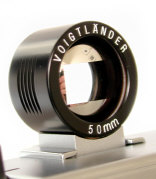
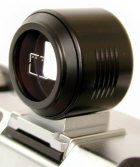
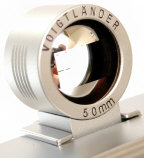
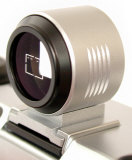
The 50mm Voigtlander
brightline finder is beautifully made a metal body and glass optics.
It shows an obvious similarity to the classic and long discontinued Leica 50mm
brightline finder. With a 1x life size magnification, the 50 Voigtlander
finder can be shot with both eyes open, a very convenient feature. The image is
very bright and clear. It has no
manual parallax compensation -- but it does have parallax compensation marks
in the finder. The lower dotted brightlines
indicate the approximate view at about 3 feet. The upper solid
brightlines
indicate the approximate view at infinity. with parallax correction marks. Metal body with glass optics, weight just over
1 oz. Brightline compensation marks in finder.
50 VF Tech Specs: 3 elements in 1 group, 1x.
magnification, -0 Diopter, weight 32 grams.
Voigtlander
50mm Brightline Anniversary Viewfinder --
101 Heliar Set version - discontinued
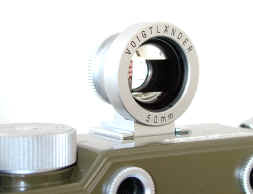
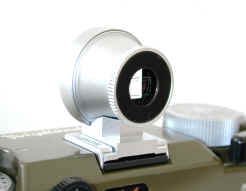
A new style 50mm brightline finder was made just for the
Bessa T 101 Heliar Anniversary set, shaped much like the 90mm brightline.
It has no
manual parallax compensation -- but it does have parallax compensation marks
in the finder. The lower dotted brightlines
indicate the approximate view at about 3 feet. The upper solid
brightlines
indicate the approximate view at infinity. with parallax correction marks.
Unfortunately the 101 50mm finder does not have the ample eye relief of the
standard production 50mm brightline. Many shooters prefer the
standard production Voigtlander 50mm brightline to this finder.
Voigtlander 75mm
Brightline Viewfinder
Order Here
75 Viewfinders
DISCONTINUED but still IN STOCK
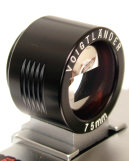
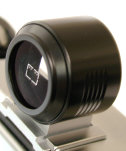
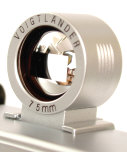
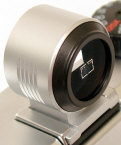
The metal 75 Voigtlander brightline
is available in either black or chrome. It is the same size as the
standard 50 brightline, they share the same outer housing. With a 1x life size magnification, the 75 Voigtlander finder can be shot with
both eyes open, a very convenient feature.
It is of metal construction with excellent fit and finish. The 75 finder
has no
manual parallax compensation -- but it does have parallax compensation marks
in the finder. The lower dotted brightlines
indicate the approximate view at about 3 feet. The upper solid
brightlines
indicate the approximate view at infinity. with parallax correction marks.
75 VF Tech Specs: 3 elements in 1 group, 1x.
magnification, -0 Diopter, weight 32 grams.
Voigtlander
90mm
Brightline Viewfinder
Order Here
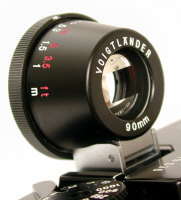
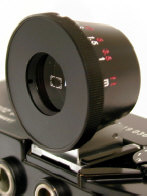
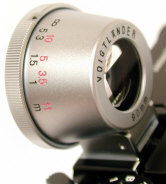
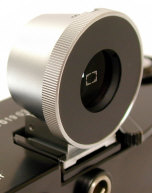
The 90 brightline was
introduced in Feb 2001 with the 90/3.5 APO Lanthar. With a 1x life size
magnification, the 90 Voigtlander finder can be shot with both eyes open, a very
convenient feature. Available in either black or chrome, the 90 is the 1st Cosina Voigtlander brightline to have dial in
parallax compensation. Predictably the image is
very bright and clear. It is of metal construction with excellent
fit and finish. 90 VF Tech Specs:
3 elements in 1 group, 1x. magnification, -0 Diopter, weight 60 grams, manually
adjustable parallax compensation from 1 meter to infinity. The outer
framelines show the field of view at infinity. The inner framelines show
the field of view at 3 feet / 1 meter.
Voigtlander Low Angle
Viewfinder
when available
Order Here
Low Angle View Finder with case with 12, 15, 21, 25 viewing attachments
This is the
ONLY modern
rangefinder viewfinder designed for low angle viewing!
These are now discontinued, sold out at the factory, and will soon very
very very hard to come by.
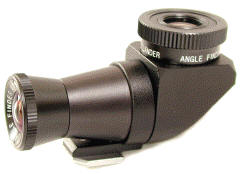
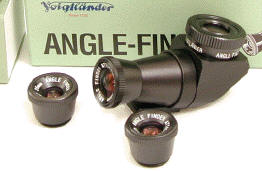
The Low Angle Finder is the first of its kind in
35mm Rangefinder history. It allows either low angle horizontal
sighting of super wides, has interchangeable lenses for 15, 21, and 25 lenses,
AND rotates for low level verticals ! While made for the Bessa, it should
be adaptable to practically any 35mm rangefinder camera, even those coming from
Germany with a name starting with L and ending in A !! Once again,
Voigtlander has beat Leica at its own game, introducing an innovative product
that Leica should have made decades ago. While the 35mm Low Angle
Finder is readily available, the Hasselblad SWC
version is discontinued and very hard to find. The Low Angle Finder was
introduced in March 2000 at the Tokyo Camera Show.
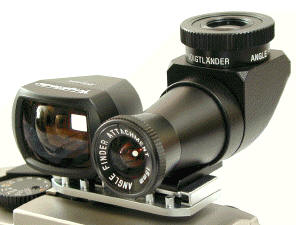
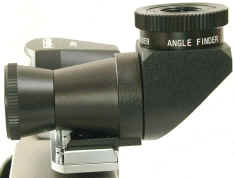
Cosina's innovation continues to amaze me.
This is a new product, the likes of which no other rangefinder manufacturer has
EVER produced. In essence, it's a waist level finder for low level
rangefinder shots, with attachments for the 15, 21, and 25 lenses. The new 12 has a
low angle attachment announced for it, but as of 6/1/01 it has not yet been released.
The rear eyepiece has a built in diopter for clear viewing, and ROTATES for even
more versatility. The view is NOT reversed left to right. It's a VERY
bright clear view, without brightline, with parallax compensation marks.
Amazingly, either way you turn the finder to the right or left, the parallax compensation
marks flip to the proper orientation. With a dual setup like the one shown
above, you can either have each finder for the same focal length, or have them different
focal lengths, to switch back and forth between lenses without having to change finders
each time.
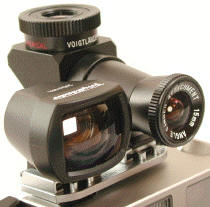
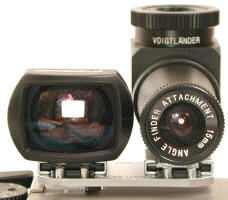
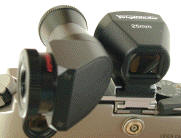
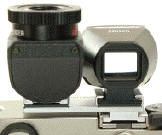
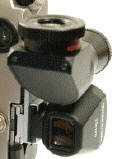
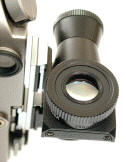
Yikes, talk about a multi-use finder !
Swung to the side as on the far left, your body can face one direction while you
take a photograph in another direction -- it's also good to use around corners in the
proverbial fire fight documentary. With the finder swung upward, you can get either VERY
low angles like you never got before with composed rangefinder shots, or turn it over your
head to get a little bit higher than the crown. With the finder swung to the side
and the camera vertical, you get low angle verticals or above the crowd verticals !
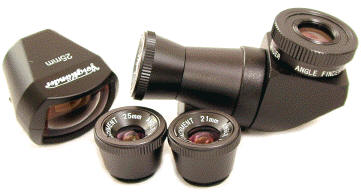
the low angle finder with 15, 21, and 25 lens attachments,
and a 25 brightline finder for size comparison
Bottom Line ?
if you are a
serious rangefinder photog, you owe it to yourself to get the low angle finder, providing
you shoot the wide angle lenses it is designed for. You will find yourself getting
new shots that before were difficult if not impossible. Some will complain
about the cost, but look again. You can get the angle finder and all three
attachments for about the same price as a single wide angle Leica finder, or three
separate focal length Voigtlander finders.
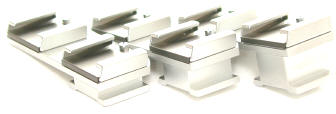
Voigtlander
Double Accessory Shoe:
Discontinued / Sold Out
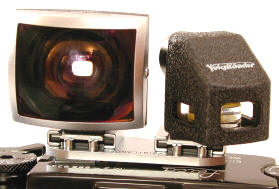
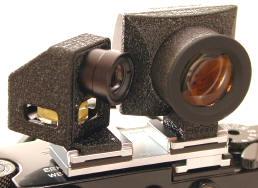
12mm Viewfinder and Sprit Level mounted on Double Shoe
Like many of the Voigtlander accessories,
these are quite unusual. There are 3 different shoes, Types A, B, or C (right to left above).
They do NOT have hot shoes. These allow you to double up on the accessories of
your choice, such as a finder and a VC meter, a VC meter and the angle finder, a VC
meter and a flash, a regular finder and an angle finder (shown below), a wide finder
and the low angle finder, or a wide finder and the bubble spirit finder.
The double accessory shoe is not quite wide enough to mount two wide angle
finders side by side, but it is wide enough to mount a wide angle finder alongside the 50,
75, or 90 finders. NOT suggested is using the double accessory shoe to mount a
flash. #1 the Flash will likely be too wide to allow you to mount anything else in
the other accessory shoe. #2 mounting a flash in the outermost accessory shoe will
likely put too much leveraged strain on ANY flash shoe. #3 this is NOT a hot shoe --
it is NOT intended to mount a flash!
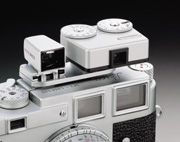 All three accessory shoe adapters have the same length
and width -- the only difference is the height of the
mounting shoe. The bottom of the mounted shoes are
coated in plastic, so they won't scratch the top of your camera. IF you
have a mixture of cameras and want to save a few bucks on Double Accessory
shoes, the Type C will fit on practically all 35mm cameras. The
disadvantage of this solution is that the higher finder height will also in
increased parallax at closer focus distances.
All three accessory shoe adapters have the same length
and width -- the only difference is the height of the
mounting shoe. The bottom of the mounted shoes are
coated in plastic, so they won't scratch the top of your camera. IF you
have a mixture of cameras and want to save a few bucks on Double Accessory
shoes, the Type C will fit on practically all 35mm cameras. The
disadvantage of this solution is that the higher finder height will also in
increased parallax at closer focus distances.
-
Type A is for relatively flat topped cameras like the
Bessa R, R2, R2S, R2C, Leica screw mounts and the Leica M's, having a mount
height of 4 mm.
-
Type B has a mount height of 7 mm, works with the Bessa
T or Nikon Rangefinders
-
Type C has a mount height of 10 mm and fits the Bessa L,
Contax II or III or meterless Kiev Contax.
Your camera not listed?
Measure your camera and find out. Each double acc shoe is 51 mm long by 20 mm
wide. The A shoe raises the accessory shoe 3mm, the B shoe 7 mm, the C shoe 10 mm.
You want to make sure the double acc shoe will extend over rewind controls, while
not covering the advance and shutter release.
If you were the kid who liked to build the biggest Tonka Toy set,
you might be tempted to combine double accessory shoes piggy back style -- but I don't
suggest it. Eventually the weight of 300 finders and flash units will tear the top
off your camera.
February 2006 UPDATE:
Type B and C Double Shoes discontinued. May 2007 Type A
Discontinued.
Voigtlander Brown Voigtlander Deluxe Camera
Case
Discontinued
Order Here
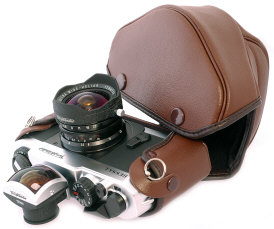
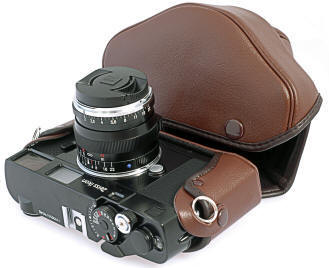
The Deluxe Brown Bessa Case is
padded and is much much nicer than the standard black camera case. It
fits all Voigtlander Bessas: L, T, R, R2, R2S, R2C, R2A, R2M, R3A, R3M, R4A,
R4M. It can accommodate
lenses as large as the 50/1.5 Nokton IF you remove the Nokton's lens shade,
as well as the Voigtlander wide angle lenses with the viewfinder, on the
Voigtlander bodies (but not the Zeiss Ikon). The top is removable for
quicker use, as well as with larger lenses like the 35/1.2, 75/2.5, and
90/3.5. Bessa camera cases use the camera's strap lugs, and have no
tripod socket. They are not usable with the Bessa Grips or the trigger
winder. The bottom half of the Bessa cases are identical,
and interchangeable between the various models. Voigtlander
cases are made of a plastic leatherette. Custom leather cases can be
found, often for more than you paid for the Voigtlander camera. In my
opinion the cases work best with the tops detached to allow easy access to
picture taking, with only the bottom of the case left on to protect the
camera. Cases are NOT included with by the factory with Cosina
Voigtlander lenses or cameras.
The standard Bessa Case has the advantage of taking the
50/1.5 with hood and cap, but can not accommodate the wide angle lenses WITH
viewfinder, or the 35/1.2, 75/2.5 and 90/3.5
Voigtlander
Lens Cases
Black VL-1 Discontinued / Sold Out
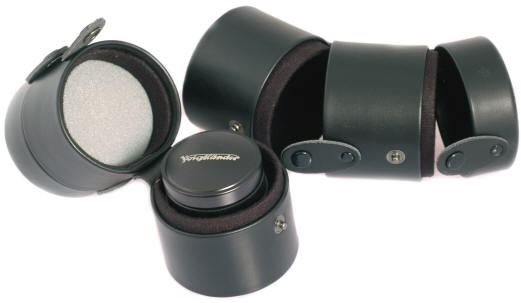
The two Voigtlander lens cases are
designed for wide angle lenses, with a foam lined top compartment for
the viewfinder, and a bottom foam lined compartment for the lens.
The VL-1 was originally designed for the 15/4.5. The VL-1 also fits
the 21/4 screw mount, 25/4 screw mount, 28/3.5, 35/2.5C, 50/3.5 and 50/2.5.
Note the VL-1 does NOT fit the later M mount 21/4P and 25/4P lenses. The VL-2 was
originally designed for the 12/5.6. The VL-2 also fits 21/4P, 25/4 P, 35/2.5 PII,
35/1.4, 40/1.4, and the 50/2 with a bit of pushing. It will also fit the
Voigtlander SC 21/4, 25/4, 28/3.5 35/2.5 made for classic Nikon and Zeiss Contax cameras. Voigtlander does not make lens cases large enough for
the 28/1.9, 35/1.7, 35/1.2, 50/1.5, 75/2.5, or 90/3.5, or the SL lens series
for SLR cameras.
Voigtlander
Bessa
Trigger Winder
Discontinued Sold Out
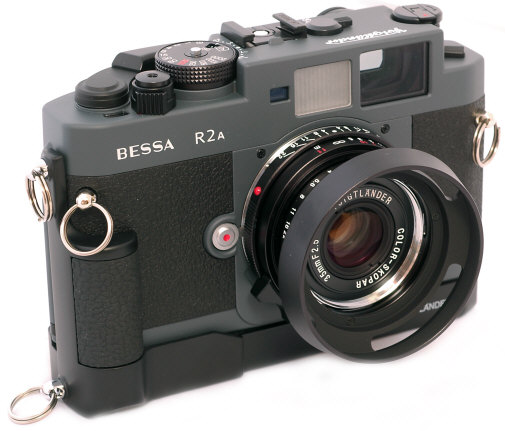
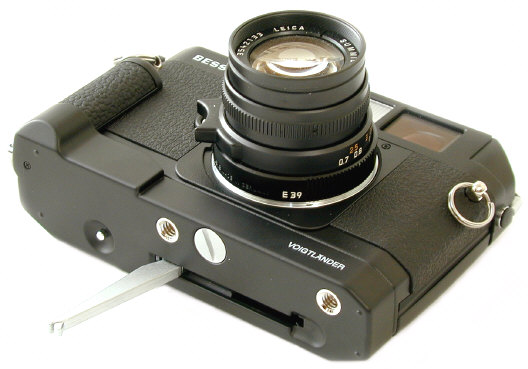
Trigger Winder mounted on gray Bessa R2A with 35/2.5
PII. Trigger Winder mounted on Bessa R2 with Leica 50/2
Summicron
What's a Trigger Winder? It's a
mechanical bottom lever film advance, an idea first used by Leica in the 1930's. Mechanical,
that's right, NO batteries. The Voigtlander Trigger
Winder is just another way to advance the film. You still use the top
mounted shutter release. With practice you can shoot 3 frames per second
without the battery dependency of a motordrive.
The Voigtlander Trigger Winder fits the Bessa T, R2, R2S,
R2C, R2A, R3A, and Bessaflex. It will not mount on the Bessa L or
R. The Trigger winder attaches easily and removes quickly via the
bottom screw to the camera base plate. You can reload the camera with
the Trigger Winder attached. It has two tripod sockets, as well as a lower
strap lug which allows vertical mounting of the camera strap.
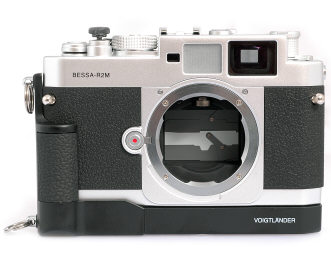
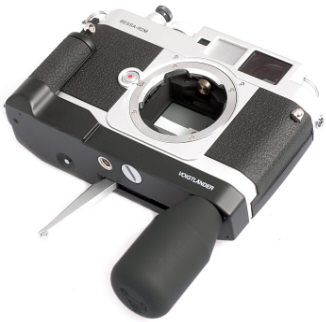
This is one "motordrive" that works without batteries.
Some shooters find the Grip A makes operation more comfortable. When
the trigger is retracted into the body, the camera is still fully
operational by the normal film advance.
If you are left eyed, you
will probably find the Trigger Winder much more convenient than hitting your
forehead with the right handed lever film advance. The Trigger Winder also
provides a comfortable grip, as well as strap lugs for mounting the camera
vertically rather than horizontally. Some photogs prefer
adding the vertical Grip A, which provides a palm rest while using
the Trigger Winder -- just like a similar grip for classic Canon rangefinder
trigger wind advances. Grip A screws into the tripod socket
at the end of the winder base plate. Try the Trigger Winder, you might be
surprised.
Voigtlander Bessa Vertical Grip
Order Here
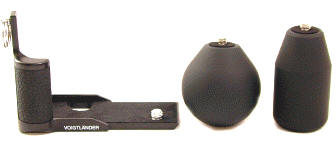
Left to right: Side Grip, Grip B (Discontinued and
Sold Out), Grip A (Discontinued, in stock)
A new series of
innovative Bessa camera grips were introduced in March 2000. Though
they are designed for the Bessa, it is obvious the A and B grip will work with many
cameras. April 2006 Ball and long grips discontinued.
Side Grips remain in production.
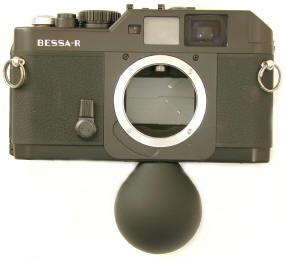
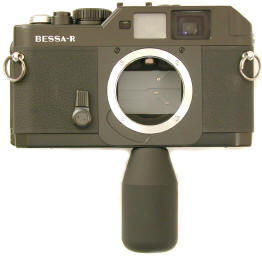
Either A or B grips can be comfortably used
easily with most any smaller camera with a center mounted tripod socket.
Strangely enough, I tried it with my M6 and it works too, though it take a bit of getting
used to. Another option is using Grip A on the Trigger Winder -- Canon
used a similar device on their rangefinder trigger winders decades ago.
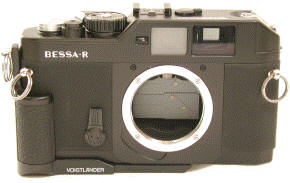
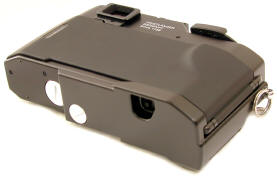
The side grip is very comfortable, and has hidden benefits.
-
a more comfortable grip
-
the grip's extra strap lug changes the balance of
the camera, so that a horizontally strapped camera will hang closer to the
body, by mounting one end of the strap on the camera, the other end of the
strap on the side grip.
-
protection for the camera's bottom plate
-
the single strap lug is
large enough to use a single anchor point and carry the camera vertically!
-
the larger base allows the camera to sit upright
with most of the 50 and smaller lenses
-
fits ALL Cosina Voigtlander Bessas
Voigtlander Spirit Level
Discontinued SOLD OUT
September 2000 saw the introduction of the
"Spirit Level" with the screw mount ultra wide 12/5.6 Heliar. While introduced with the 12mm, this bubble level can be used with
practically any lens, whether mounted in the accessory shoe of your SLR or on your
Rangefinder, side by side your wide angle finder on the double accessory
shoe as shown in the picture above. Designed with maximum versatility in mind, this
ingenious level is usable not only with other 15, 25, 28, and 35 Voigtlander wides,
but also with other makes of rangefinder cameras and lenses, such as those popular in
Wetzlar and Solms.
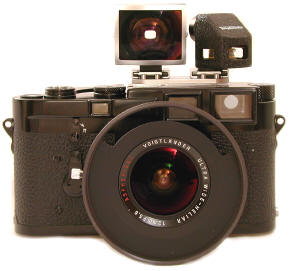
12/5.6 mounted on a Leica M3, with the 77mm filter adapter, spirit
bubble level, and double accessory shoe.
The "sprit level" is a unique
bubble level, marvelously designed to be better than any other 35mm bubble level ever
made. It's stoutly made of metal with a
black crinkle finish, offering both direct and optical leveling.
Notice
the bubble is easily visible from all four sides, allowing the photog to level the camera
quickly. Amazingly, the best vision of the bubble is though the rear eyepiece,
designed so that the shooter can look though the 12mm finder and the bubble level
SIMULTANEOUSLY. The fixed mount of the bubble level is angled towards the
presumed side by side wide angle finder for the photog's convenience. Geez,
it's amazing what can happen when the chief designer (Cosina's President Mr.
Kobayashi)
is an experienced photog.
Deluxe Voigtlander Camera Strap
Discontinued, Sold Out
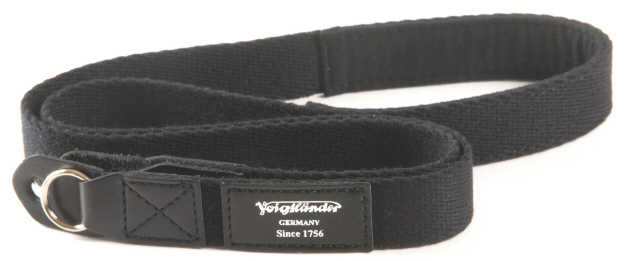
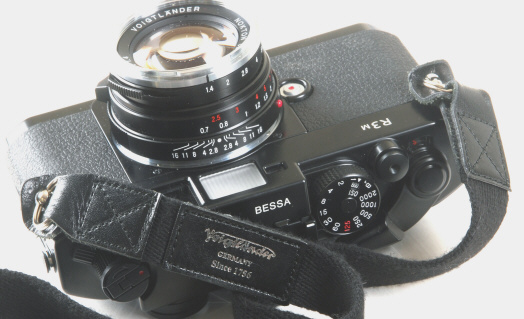
This is a very nice fixed length camera strap,
originally available in either black or olive. The olive straps are
discontinued and now sold out. The Voigtlander Deluxe Strap is
constructed of high strength 3/4" rope fabric,
35" length ring to ring.
It is has leather reinforcements on the strap ends, and leather inserts to
protect camera body from strap rings. "Voigtlander Germany
Since 1786" is inscribed on the leather insert. The middle of the strap is
also reinforced for better neck support. The fixed strap length is 35." I
find it an excellent strap for most cameras -- of any make!
Bessa Eyepiece and
Diopters
same as Nikon FM / FE series
eyepieces
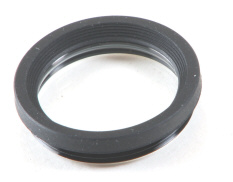
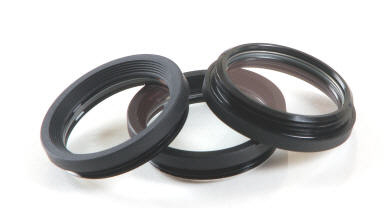
Standard Replacement Eyepiece Diopter Eyepieces
The screw in eyepieces of the Voigtlander Bessa R2A,
R2M, R3A, R3M, R4A, R4M, Bessaflex, Bessa III, Bessa III Wide, Zeiss
Ikon ZM, and Fuji X-Pro1 all take the same standard plain eyepiece and
optional diopters. Tighten them down so they won't work
loose. The diopters are available in increments of one, from -3,
-2, -1 to +1, +2 and +3.
Which Strobe For Your
Bessa?
AS you may have noticed, there are
no Voigtlander strobe units. The Cosina Voigtlander Bessas do not have
dedicated flash circuits, so they don't required dedicated flash units.
Personally I use the flashes from my Nikon SLRs on my Bessas, set to auto
using the sensor on the flash. You select your desired f/stop on the
flash, then transfer that f/stop to your lens and shoot away. Of
course you can use practically any flash unit with its own auto sensor, not
just Nikon flash units.
My Favorite Voigtlander Accessories
My own favorite Voigtlander accessories in terms of the
most often used, are the side grip, MiniSoftRelease,
and the deluxe Voigtlander camera strap. Each of my personal Bessas,
Leica M's, and Nikon rangefinders are so equipped. The Voigtlander finders offer
fantastic value for the money. The new 2010 15-35 Zoomfinder and
Version II 12, 15, and 21/25 metal viewfinders are the best super wide
Voigtlander viewfinders yet. The double accessory shoe with a VCII meter and the
appropriate finder for your lens offer versatility for older non metered
cameras that simply has never been available before. I love the VCII
meter on my M2, M3, IIIg, and Nikon SP. The low angle
finder is in a class by itself, a unique great finder if low angle RF shots
are your cup of tea.
Damn, I love to see intelligently
designed accessories that make picture taking easier.
Revised:
February 09, 2024
. Copyright � 2001-24 Stephen Gandy. All rights reserved. This means you may NOT
copy and re-use the text or the pictures in ANY other internet or printed
publication of ANY kind. Information in this document is subject to change
without notice. Other products and companies referred to herein are
trademarks or registered trademarks of their respective companies or mark
holders.